On Art and Politics

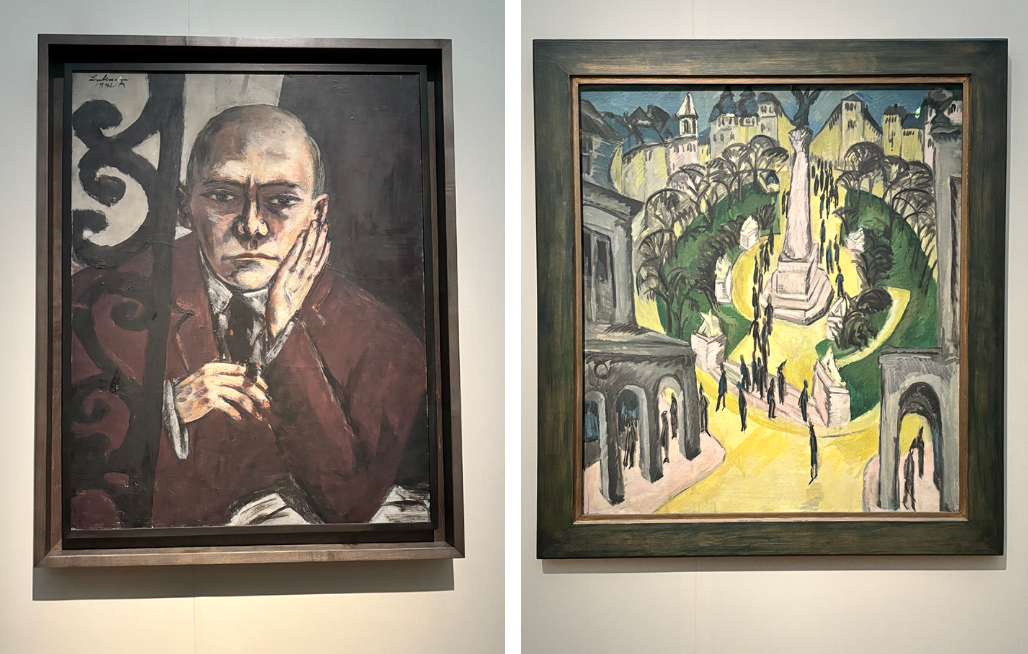
Earlier this month, we took a long weekend and headed up to Fort Worth to see the exhibition Modern Art and Politics in Germany 1910-1945 at the Kimbell Art Museum, one of the best places in the world to experience art. The exhibition featured works from the Neue Nationalgallerie Berlin and two thirds of them had never been on view in the United States before (so exciting!).
The theme of the exhibition was the role of art and artists in repressive times. It shows artists grappling with the turbulent World War I era and the increasingly authoritarian political culture leading up to the Third Reich. Both their subject matter and their artistic style shifted during this time and we, with the benefit of hindsight, can see the descent into the madness that wouldn’t end until 1945. It was deeply moving and worryingly relevant.
Many of the artists in the exhibition – Otto Dix, Ernst Ludwig Kirchner, Georg Grosz, Emil Nolde, and Wassily Kandinsky and others – were declared degenerate in 1937 and had their work confiscated from museums to be included in the now famous Degenerate Art exhibition in Munich.
One of the paintings in this current show, The Sinner (Christ and the Sinner) by Nolde was also included in that exhibition. Interestingly, Nolde was a Nazi party member and an avowed antisemite. He thought this would put him on the regime’s good side, but it did not. He was outraged that his work was included.
The show ran from 19 July to 30 November 1937 at the Institute of Archaeology in the Hofgarten in Munich, as counter-programming to the government-approved Great German Art Exhibition at the Haus Der Kunst just across the street. That exhibition displayed work that met the mandated, classically inspired “representation of the perfect beauty of a race steeled in battle and sport.”
After the Degenerate show closed, Nazi-sanctioned art dealers were commissioned to sell the works abroad to help fill Germany’s war coffers, but not before several high ranking officials, among them Hermann Goering, helped themselves to several pieces “for educational purposes.” Many others from the exhibition and thousands more from museums around the country were destroyed by burning, not in public displays as had been done for books, but secretly, in the courtyard of Berlin’s main fire station. Some paintings that were marked destroyed have since turned up elsewhere.
The German Art Exhibition ran from 1937 until 1944, presented 12,550 exhibits, and was visited by around 600,000 people. In contrast, the Degenerate Art exhibition presented 650 works, and, during its 4 ½-month run, drew more than two million visitors, an average of 20,000 people per day.